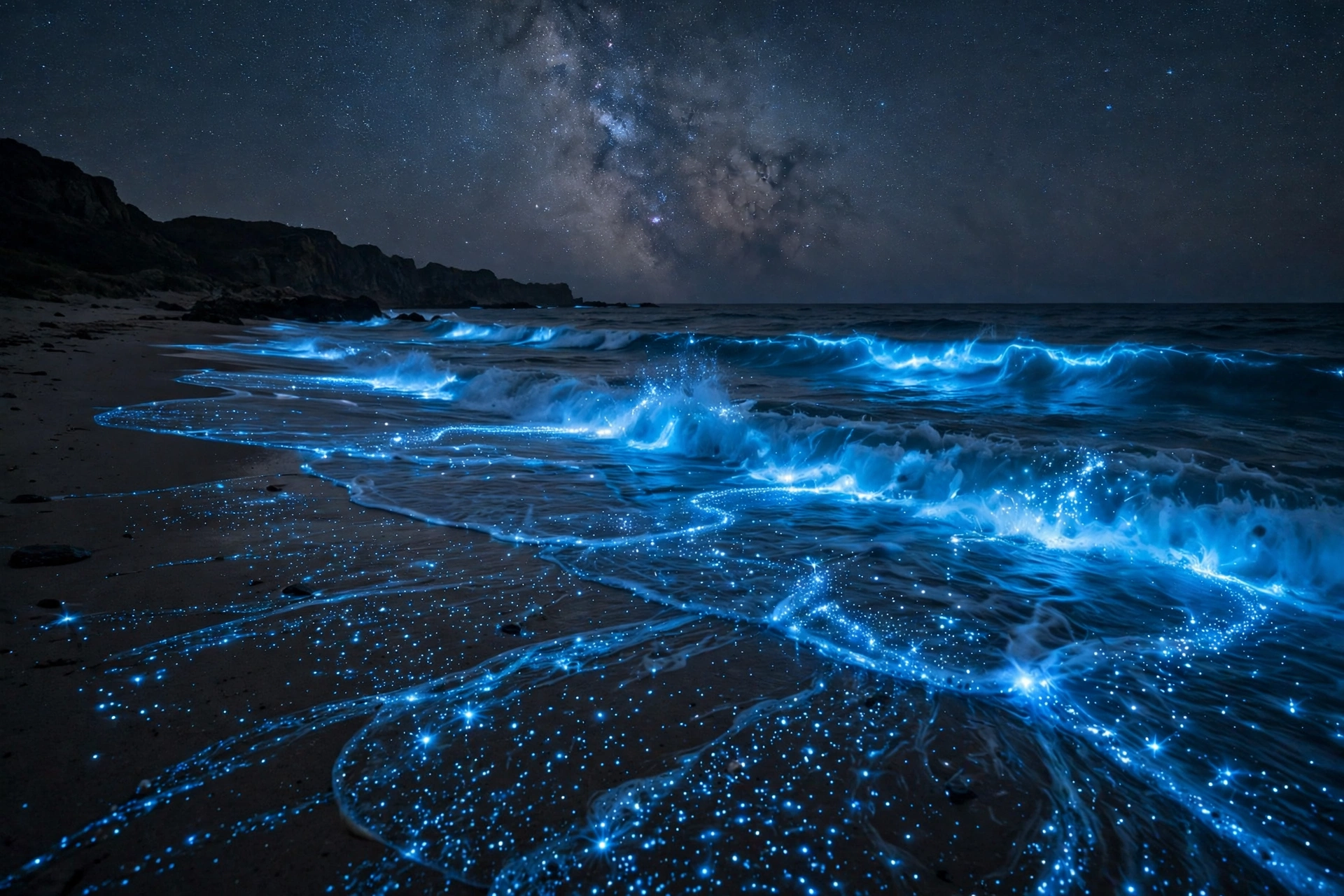
Imagine standing on a dark beach at midnight when the surf suddenly lights up — every wave breaking in electric blue, your footprints sparkling behind you as if the sand itself were wired for light. Travellers describe that moment as unforgettable, and some call it a “beautiful blue death.” But what are you actually looking at, is it dangerous, and where can you see it for real? This guide separates the poetry from the science, so you know what the glow is, when it is safe, and how to plan a trip around it.
First, an Honest Correction: “Beautiful Blue Death” Is Not a Scientific Term
Let us be straight with you: “beautiful blue death” is not an established name in ocean science. You will not find it in marine biology textbooks or on a research station’s species list. What people describing glowing blue waters are almost always talking about is bioluminescence — light produced by living organisms in the sea. The phrase seems to have grown up online as a dramatic label for that glow, mixed with the very real fact that some glowing or discoloured waters can be dangerous. Keeping those two ideas separate matters, because the beautiful part and the dangerous part are usually different things.
The Real Science: Why the Sea Glows Blue
The glow most travellers see comes from dinoflagellates, microscopic plankton that emit a flash of blue-green light when disturbed — by a wave, a paddle, or your hand in the water. The light comes from a chemical reaction inside the organism, and scientists believe it startles predators, giving the plankton a better chance to survive. It is most vivid on dark, moonless nights, and it needs calm, warm, nutrient-rich water with a high concentration of these organisms — which is why only a handful of bays and beaches glow reliably enough to plan a trip around. Photos tend to exaggerate it: long camera exposures gather light your eyes cannot, so expect a magical shimmer rather than a neon flood.
When Glowing Water Is Actually Dangerous
Here is where the “death” half of the phrase earns a cautious hearing. Not every glowing or strangely coloured sea is safe. Some algal blooms — often called red tides — produce toxins that can irritate skin and lungs, contaminate shellfish, and kill marine life. These blooms are usually reddish or brownish rather than sparkling blue, and local authorities issue advisories when they occur. The rules are simple: never swim in water under an official health advisory, never drink seawater or eat shellfish from an affected area, and follow local guidance over anything a travel blog tells you. Bioluminescent bays run by licensed operators are a different situation from an unexpected bloom on an unmanaged beach — but if the water looks odd and no one local can explain it, stay out.
Where to See Bioluminescence for Real
Three places top nearly every reliable list. Mosquito Bay, Vieques, Puerto Rico, holds the Guinness record as the world’s brightest bioluminescent bay; visit on a moonless night in the dry season, roughly December to March, and go by kayak with a licensed operator — swimming and powered boats are banned there to protect the ecosystem. Vaadhoo Island in the Maldives, famous as the “Sea of Stars,” is where waves wash sparkling plankton onto the sand; if you are already dreaming of that part of the world, our guide to the Maldives covers the islands as a destination. Luminous Lagoon in Jamaica, near Montego Bay, is one of the few famous glowing bays where swimming is allowed, and it is best on dark nights away from heavy rain, which can cloud the water. A different spectacle worth knowing about is Toyama Bay in Japan, where the glow comes not from plankton but from firefly squid — a reminder that “glowing sea” covers more than one creature.
Planning Tips for a Night on the Water
Book around the new moon — moonlight washes out the glow — and check recent visitor reports, since bioluminescence varies with season, weather, and water conditions and is never guaranteed on a given night. Choose licensed local guides: they know the rules, the safest entry points, and how to run a tour without damaging the ecosystem. Leave the flash off your camera, avoid sunscreen and insect repellent in the water where operators ask you to, and do not try to collect glowing water in a bottle — the organisms die quickly out of the sea, and the glow dies with them.
Frequently Asked Questions
Is a “beautiful blue death” a real phenomenon?
Not under that name. The real phenomenon behind the phrase is bioluminescence, usually from dinoflagellate plankton. The “death” idea comes from confusing that glow with toxic algal blooms, which are a separate and genuinely hazardous occurrence.
Can you swim in bioluminescent water?
It depends on the location. Swimming is allowed at Jamaica’s Luminous Lagoon but banned at Mosquito Bay in Vieques, where kayaking is the way to see it. Always follow the rules of the specific bay you visit.
When is the best time to see the glow?
On dark, moonless nights, in the local peak season — roughly December to March for Mosquito Bay, and the calmer, warmer months for Vaadhoo. Check recent local reports before booking, since conditions change.
Final Thoughts
The sea really does glow, and it really is beautiful — but it is bioluminescence, not a “beautiful blue death,” and the danger lies not in the sparkle but in ignoring local warnings about toxic blooms. Go on a moonless night, go with a licensed guide, and keep your expectations honest: you may see a gentle shimmer rather than a Hollywood light show, and that shimmer, on a dark beach at midnight, is more than enough.