You sit on your mat, lean back slightly, and lift your legs until your body forms a V. Your core shakes, your breath shortens, and you wonder how such a simple shape can be so demanding. That shape is Navasana, or boat pose — a classic yoga posture that builds core strength, balance, and focus. This guide explains what Navasana actually does, how to practise it safely, and how to build it up step by step.
What Is Navasana?
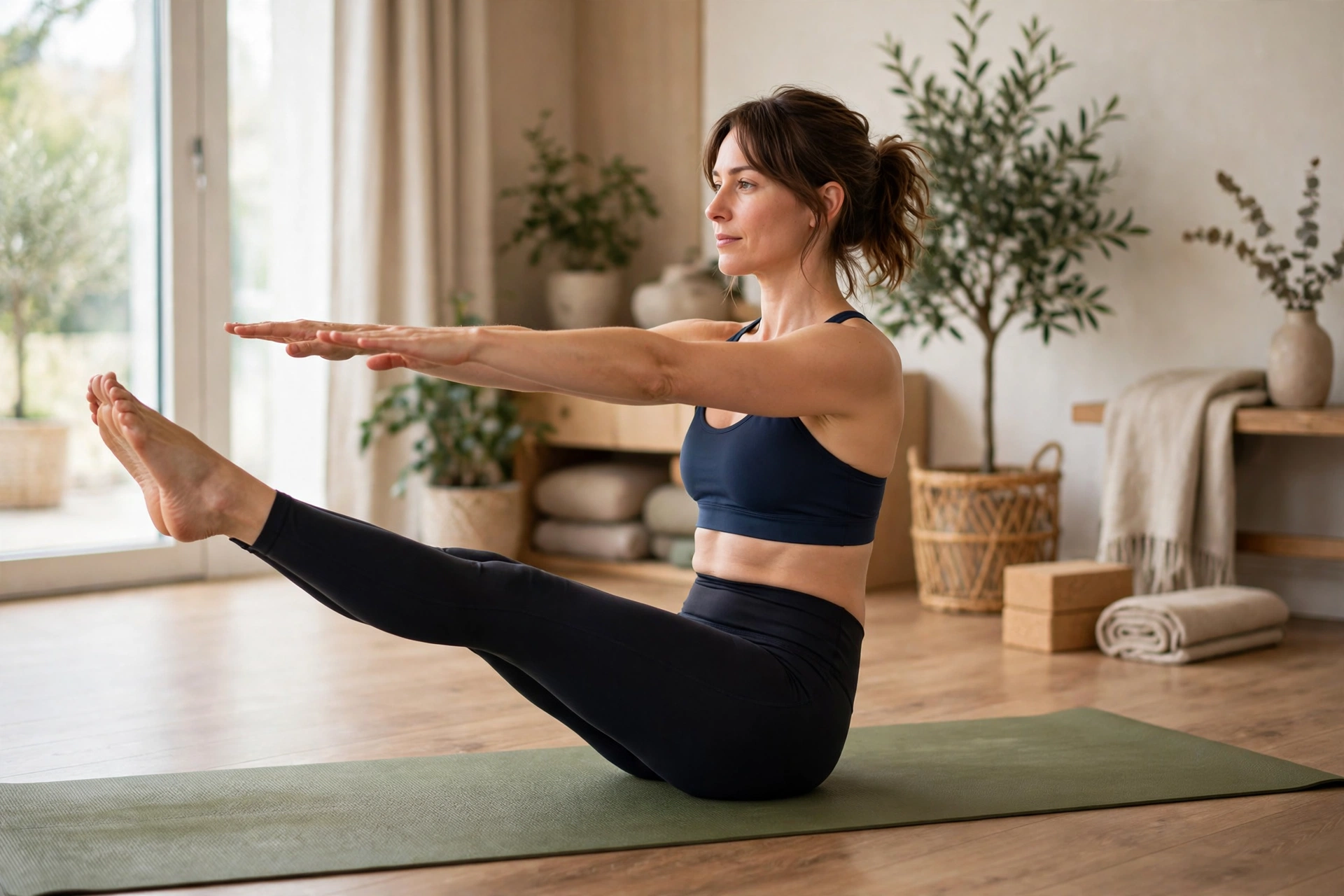
Navasana comes from the Sanskrit words nava (boat) and asana (posture). In the full pose, you balance on your sit bones with your torso and legs lifted, arms extended forward alongside your legs. The shape resembles a boat, and holding it asks your abdominal muscles, hip flexors, and back muscles to work together while you stay steady and breathe. It appears in many yoga sequences as a core-strengthening posture and as preparation for arm balances and other poses that need a stable centre.
How to Practise Navasana, Step by Step
Start seated on your mat with your knees bent and feet flat on the floor. Place your hands lightly behind your thighs, lengthen your spine, and lift your chest. Lean back slightly, keeping your back long rather than rounded, and lift one foot, then the other, so your shins are parallel to the floor. When that feels steady, extend your arms forward, parallel to the floor, palms facing each other. If your balance and strength allow, straighten your legs so your body forms a V, with your toes roughly at eye height.
Breathe normally throughout — holding your breath is a sign you are pushing too hard. Aim for five slow breaths to begin with, then lower your feet to the floor and rest. Two or three rounds, with rest between them, is plenty for a regular practice. Quality matters more than duration: a steady, well-aligned hold for a few breaths teaches your body far more than a wobbly minute.
Easier Variations for Beginners
Boat pose is challenging, and there is no need to force the full shape. Keep your knees bent with shins parallel to the floor — this is Ardha Navasana, or half boat pose, and it is a complete practice in its own right. Hold the backs of your thighs for support if your balance feels unsteady, or place your hands on the floor beside your hips. You can also practise with a wall behind you, or with a folded blanket under your sit bones if your lower back rounds. Build up gradually: when bent-knee boat feels steady for several breaths, try straightening one leg at a time before attempting both.
What Navasana Can — and Cannot — Do for You
Practised regularly, Navasana strengthens the abdominal muscles, including the rectus abdominis, obliques, and the deeper transverse abdominis, and it works the hip flexors that lift the legs. Because balance is part of the pose, it also trains focus and coordination: you cannot hold boat pose while your mind wanders. Many practitioners find it improves their posture, since a stronger core supports an upright spine, and it builds the stability used in everyday movements like standing, walking, and lifting.
It is worth being honest about the limits. A yoga pose does not “detoxify” your kidneys, and there is no reliable evidence that Navasana directly stimulates the thyroid in a clinically meaningful way. Claims like that appear in older yoga writing, but they should be treated as tradition, not medical fact. What Navasana reliably offers is strength, balance, and body awareness — which is plenty. If you are practising for a health condition, treat yoga as general exercise and wellbeing, not as treatment, and talk to a qualified professional about your specific situation.
Common Mistakes to Avoid
The most common mistake is rounding the lower back and collapsing the chest, which loads the spine instead of the core. If your back rounds, bend your knees or use your hands for support until you can keep your spine long. Another is holding the breath or clenching the jaw and shoulders — soften your face, relax your shoulders away from your ears, and keep breathing. Rushing is a third mistake: jerking into the pose with momentum may look impressive, but it teaches nothing and risks strain. Enter slowly, hold steadily, and exit with control.
Who Should Modify or Skip Navasana
Boat pose puts real load on the abdominal wall and lower back, so it is not suitable for everyone in its full form. If you have a back injury, a hernia, or significant lower-back pain, or if you are pregnant, skip the full pose or practise only a supported, bent-knee version after checking with a qualified instructor or healthcare professional. The same applies if you feel sharp pain rather than muscular effort — discomfort in the muscles is normal, sharp or pinching pain is a signal to stop. This article is general information, not medical advice, and a qualified teacher in person can adjust the pose to your body far better than any written guide.
Building Navasana Into Your Practice
Boat pose works well near the middle or end of a practice, once you are warm. Pair it with a gentle counter-pose afterwards, such as lying on your back with knees hugged to the chest, to release the abdomen and lower back. Practise two or three times a week rather than forcing it daily, and track progress by steadiness, not by how long you can hold on: a calm five-breath hold with a long spine beats a shaky thirty seconds. Over weeks, you will notice the shake lessen, your balance improve, and the pose feel less like a struggle and more like a skill. That steadiness carries over, too — the focus you practise on the mat is the same focus that helps you stay calm under pressure off it, which is why keeping your mind in the best condition and training your body go hand in hand.
Frequently Asked Questions
How long should I hold Navasana?
Begin with five slow breaths, or about 20–30 seconds, for two or three rounds. Build up gradually as your strength and steadiness improve. There is no benefit in holding a collapsing pose for a long time.
Why do my legs shake in boat pose?
Shaking is normal, especially at first. It means the muscles are working hard and your nervous system is learning to coordinate the balance. It usually lessens with regular practice. If shaking comes with pain, stop and rest.
Is Navasana good for back pain?
A stronger core can support better posture, which helps some people, but boat pose itself can aggravate existing back problems. If you have back pain or an injury, get personal advice before practising it, and start with supported variations only.
Final Thoughts
Navasana is a small pose with an outsized effect: it asks for strength, balance, and attention all at once, and it rewards patience. Start with bent knees, keep your spine long, breathe steadily, and let the full boat shape arrive in its own time. Practised honestly, without exaggerated health claims, it is one of the most useful postures in yoga — a direct, measurable way to build a stronger, steadier centre.