
You open your banking app at the end of the month, and the numbers never quite add up. You earned a decent income, you did not buy anything extravagant, and yet the balance is lower than you expected. If that feeling sounds familiar, you do not need a complicated spreadsheet or a finance degree. You need a simple rule you can actually stick to — and that is exactly what the 50/30/20 budget rule offers.
This guide explains the 50/30/20 rule in plain language: what each percentage covers, how to work out your own numbers, how to adjust the rule when your income or rent makes the standard split unrealistic, and the mistakes that trip up most beginners. By the end, you will have a complete first-month budget you can set up today.
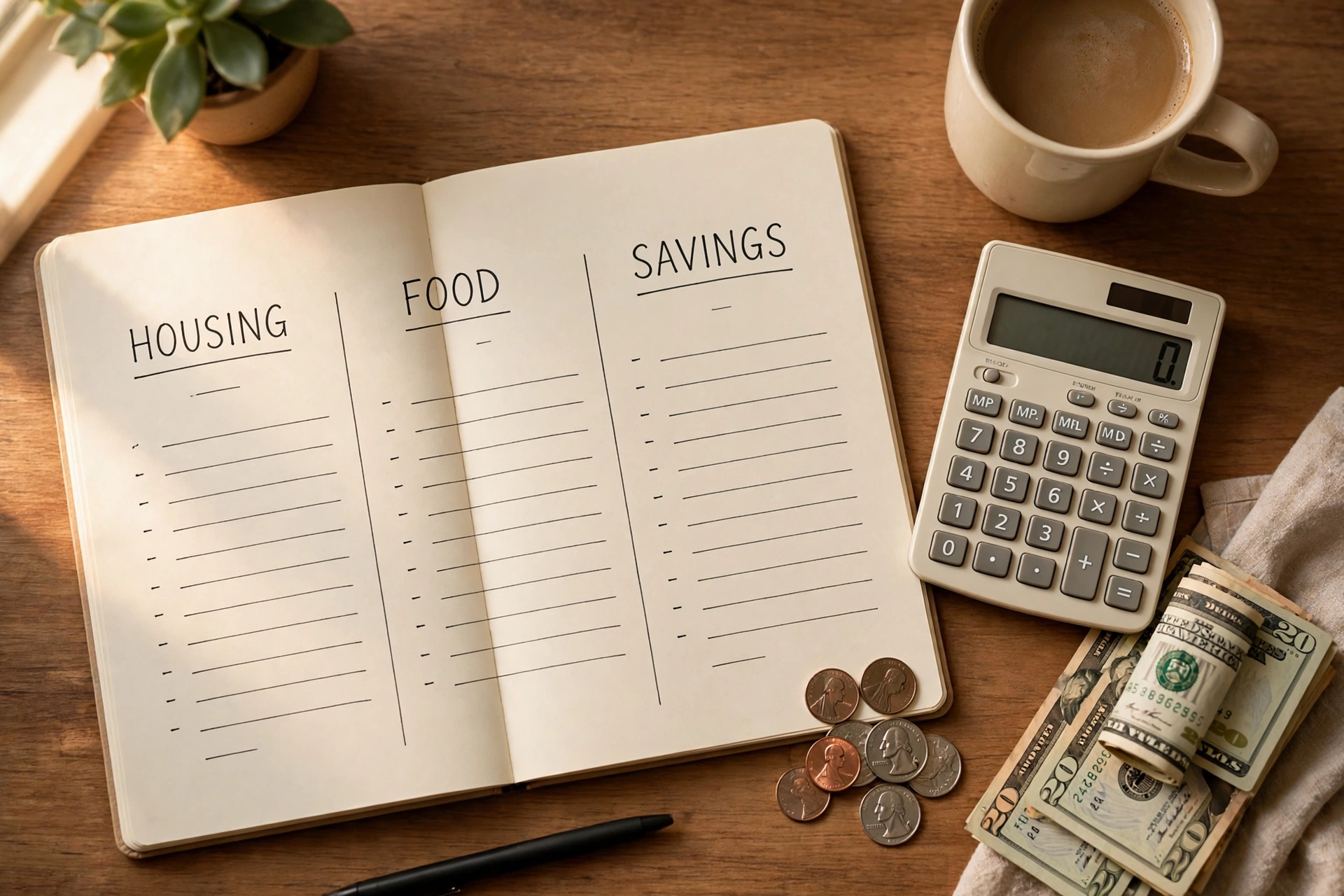
What Is the 50/30/20 Rule?
The 50/30/20 rule is a simple budgeting framework that divides your after-tax income into three buckets. You spend 50% on needs, 30% on wants, and 20% on savings and debt repayment. It was popularised by US Senator Elizabeth Warren and her daughter Amelia Warren Tyagi in their book All Your Worth, and it has endured because it is easy to remember and easy to check.
The key word is after-tax income: the money that actually lands in your account after taxes and mandatory deductions. Budgeting from your gross salary will overstate what you have available and quietly break the plan before the month even starts.
The Three Buckets, Explained
50% for Needs
Needs are the essentials you must pay to live and work: rent or mortgage payments, utilities, groceries, basic transport to work, minimum loan payments, and essential insurance. If you stopped paying for a need, you would face a serious consequence — eviction, a disconnected utility, or an inability to get to work.
30% for Wants
Wants are everything that makes life enjoyable but is not essential: eating out, streaming subscriptions, holidays, new clothes beyond replacements, hobbies, and upgrades. Wants are not wasteful — a budget that leaves no room for enjoyment is a budget you will abandon. The 30% cap simply keeps them in proportion.
Travel is a classic want that deserves its own line in your budget rather than a vague hope. If a trip is on your horizon, plan its cost the same way you would any other want — for example, by working through how to plan a road trip on a budget before you commit to dates and bookings.
20% for Savings and Debt Repayment
The final 20% goes to your future self: an emergency fund, retirement savings, extra debt payments above the minimum, and savings goals such as a house deposit. Paying only the minimum on a loan counts as a need; anything above the minimum belongs here, because it shortens the debt and reduces the interest you pay overall.
If you do not yet have a safety net, start this bucket with an emergency fund before anything else. A small, separate fund turns a broken appliance or an unexpected bill from a crisis into an inconvenience, which is why building an emergency fund on a low income is the most practical first savings goal for most beginners.
How to Calculate Your 50/30/20 Budget
Work through these four steps with last month’s bank statement in front of you — real numbers beat estimates every time.
- Find your after-tax monthly income. Add up your take-home pay. If your income varies, use the average of the last three months, or the lowest month if you want a cautious plan.
- Multiply by 0.50, 0.30 and 0.20. Those three figures are your target limits for needs, wants and savings.
- Sort last month’s spending into the three buckets. Be honest about borderline items: a basic phone plan is a need, but the premium upgrade is a want.
- Compare and adjust one thing at a time. If needs take 65%, do not try to fix everything in a week. Move one expense — a subscription, a food-delivery habit — and re-check next month.
A Worked Example
Suppose your after-tax income is $3,000 a month. Your 50/30/20 targets would look like this:
| Bucket | Percentage | Monthly amount | Typical items |
| Needs | 50% | $1,500 | Rent, utilities, groceries, transport, minimum loan payments |
| Wants | 30% | $900 | Dining out, streaming, hobbies, holidays |
| Savings and debt | 20% | $600 | Emergency fund, retirement, extra debt payments |
The example uses dollars for clarity, but the method works in any currency: take your own after-tax income, apply the same three percentages, and the table fills itself in.
When 50/30/20 Does Not Fit Your Life
The rule is a starting point, not a pass-or-fail test. In an expensive city, rent alone can push needs above 50%, and on a low income the same can happen. That does not mean budgeting has failed — it means the percentages need adjusting.
- High housing costs: try 60/25/15 temporarily while you work on the biggest lever — housing, transport, or income — rather than cutting every small pleasure at once.
- Low or irregular income: protect the savings bucket first, even at 5–10%, so the habit survives lean months. You can raise the percentage as income grows.
- High-interest debt: consider flipping the wants and savings buckets for a few months (50/20/30) to clear expensive debt faster, then return to the standard split.
Whatever split you choose, keep the same discipline: needs first, a capped amount for wants, and savings treated as a bill you pay yourself on payday, not whatever is left at month-end.
Common Beginner Mistakes to Avoid
- Budgeting from gross pay. Taxes are not available to spend. Always start from take-home pay.
- Guessing instead of tracking. Most people underestimate food and subscription spending by a wide margin. One month of real data fixes this.
- Calling everything a need. A gym membership you never use and a premium streaming bundle are wants, however familiar they feel.
- Setting a perfect budget and quitting after one bad week. A budget is reviewed monthly, not judged daily. Overspending in one category is information, not failure.
- Leaving savings until the end of the month. Automate a transfer on payday so the savings bucket is filled before wants can absorb it.
Your First-Month Setup Checklist
- Write down your after-tax income and calculate your three target amounts.
- Sort last month’s spending into needs, wants and savings.
- Set up one automatic transfer to savings on payday, even a small one.
- Pick one want to trim and one need to review (for example, an unused subscription and a utility tariff).
- Put a 15-minute monthly review in your calendar to compare actual spending with your targets.
FAQ:
Is the 50/30/20 rule good for beginners? Yes. Its strength is simplicity: three buckets are easy to remember and check, which is why it works well as a first budget. You can move to a more detailed system later once the habit is in place.
Should I include taxes in the 50/30/20 calculation? No. Use after-tax income only, so every percentage refers to money you actually control.
What if my needs are more than 50% of my income? Adjust the split temporarily — for example 60/25/15 — and focus on the largest expenses or on raising income, rather than forcing an unrealistic target.
Does debt repayment count as savings or as a need? Minimum payments are needs. Extra payments above the minimum count toward the 20% savings and debt bucket.
Final Thoughts
Budgeting with the 50/30/20 rule is not about perfection; it is about proportion. When your needs, wants and savings each have a clear limit, you stop guessing at the end of the month and start making deliberate choices during it. Calculate your three numbers, automate your savings, review once a month, and let the rule do the quiet work of turning a variable income into a stable plan. This article offers general educational information, not personalised financial advice — if your debts or tax situation are complex, a qualified financial adviser can tailor a plan to your circumstances.