
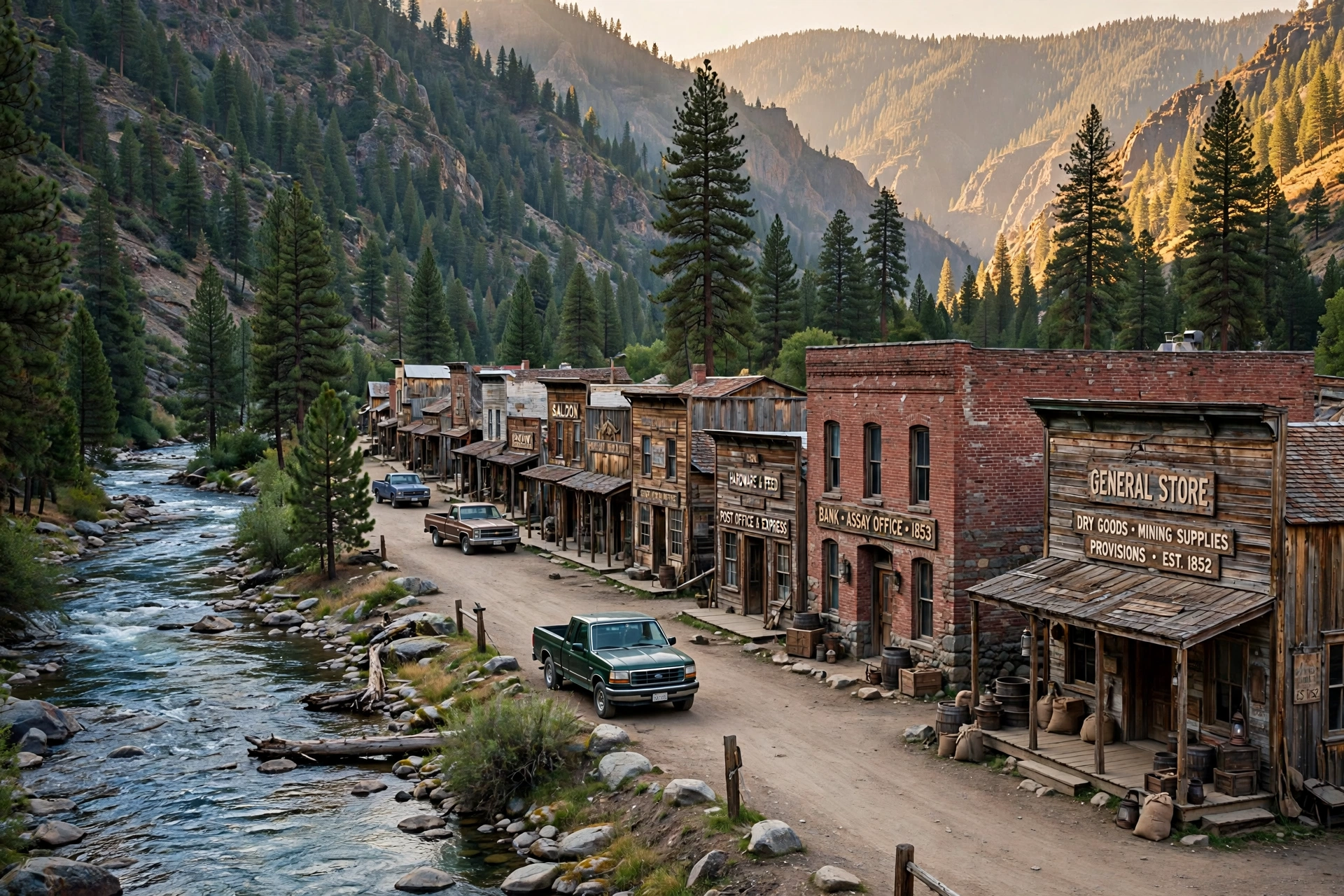
Drive north from Grass Valley on Highway 49 and the road starts to climb, bending through pine forest and steep canyon walls until the North Fork Yuba River appears below you. Then the canyon opens just enough for a town: a short main street of weathered storefronts, a river running clear and cold beside it, and forested slopes rising on every side. That is Downieville — and if you are thinking about buying property here, you need to understand the place first, because the town itself is the whole story.
What Downieville Actually Is
Downieville is a census-designated place and the county seat of Sierra County, California, sitting on the North Fork of the Yuba River at an elevation of 2,966 feet. The 2020 census counted just 290 residents, and Sierra County as a whole — California’s second-least populous county — had only 3,236 people. Gold was first discovered here in 1849, and the town held more than 5,000 residents in the 1850s, when it was one of the busiest mining camps in the Sierra Nevada. Today it is a quiet mountain town where the courthouse, a handful of shops and cafes, a small school and a clinic serve a community that values quiet over growth.
That smallness is not a flaw to work around — it is the defining fact of Downieville real estate. There is no subdivision pipeline, no new-build estate, no busy high street. Inventory is thin, properties change hands slowly, and the market runs on local knowledge and patience. Anyone who tells you this is a fast-moving market with prices about to take off is selling you something, not describing the town.
What Kind of Property You Will Find
Most homes in Downieville fall into a few familiar types. There are historic Gold Rush-era houses and cottages along Main Street and the side streets, some carefully restored and some that have waited a long time for the next owner willing to take them on. There are cabins tucked into the trees above the river, and there are vacant lots — some flat and buildable, many steep, forested, or reachable only by narrow roads.
Condition varies widely, and that matters more here than in a city market. A historic home can hide old wiring, aging plumbing, a roof that has seen many Sierra winters, or a foundation that has shifted on a canyon slope. Rural properties often rely on well water and septic systems rather than town services, and a buyer should have both checked by a specialist before committing. Before you buy a lot, find out whether it has legal road access, what the slope and drainage are like, and whether the parcel can actually support the home you imagine. A cheap lot that cannot be built on is not a bargain.
The Honest Case for Buying Here
People buy in Downieville for the setting, and the setting is genuinely remarkable. The North Fork Yuba runs through town, the surrounding Tahoe National Forest offers hiking, trout fishing and quiet that is hard to find anywhere else in California, and the Sierra Buttes Lookout trail climbs to nearly 9,000 feet a short drive away. Downieville is also famous in the mountain-biking world: the Downieville Downhill drops roughly 15 miles and more than 4,000 feet from Packer Saddle back into town, and the Downieville Classic race and festival fills the town each summer.
The community is another real draw. In a town of under 300 people, neighbours know each other, local events are genuinely local, and the pace of life is slow by design. California’s oldest weekly newspaper, the Mountain Messenger, has been published here since 1853 — a small detail that says a lot about how rooted this place is. If you want a full-time home in the mountains, a weekend retreat, or a base for a genuinely outdoors life, Downieville offers something few California towns still can.
The Trade-Offs to Weigh Before You Buy
The same remoteness that makes Downieville peaceful also makes everyday life a project. The nearest larger town, Grass Valley, is roughly an hour’s drive away on Highway 49, and that is where you will go for a full supermarket shop, most medical care and many services. Winter brings snow at nearly 3,000 feet, and canyon roads demand respect in bad weather. Heating a mountain home through a Sierra winter costs real money, and you should budget for it honestly.
Wildfire is a serious consideration across the Sierra Nevada. Before buying, ask about fire insurance availability and cost — in high-risk areas of California, cover can be expensive or hard to find — and look at the defensible space around any property. If you plan to work remotely, check mobile signal and internet options at the exact address before you buy, because coverage varies street by street in a canyon town. And if you are imagining a vacation rental, check Sierra County’s current short-term rental rules first; do not assume a property can be rented out.
Finally, understand the resale picture. A thin market cuts both ways: there is little competition when you buy, but there will be few buyers when you sell. A Downieville home can take a long time to find its next owner, so this is a poor choice if you need a quick exit or a guaranteed return.
How to Buy Well in a Tiny Market
Buying in a town like Downieville rewards patience and local help. Work with a real estate agent who actually knows Sierra County — a generalist from the valley will not know which streets flood, which lots have access problems, or which homes have been sitting for a reason. Visit in more than one season: a street that feels charming in June can feel very different in January, when daylight is short and the road is icy.
When you find a property you like, inspect it like you mean it. Get a thorough home inspection, a roof assessment, and checks on the water supply and septic system. Ask about fire insurance quotes before you go under contract, not after. Read the title report carefully, including any easements or old mining-era claims that still appear on rural parcels. And if you are buying land, it helps to understand how owner-financed land deals work — seller financing is one of the ways rural land changes hands, and knowing how it works helps you judge whether an offer is fair. Buying in another small town follows the same logic: our guide to buying real estate in Freeville, New York covers the same small-market checks — thin inventory, local knowledge and honest pricing — from the other side of the country.
What It Costs — and What It Does Not Promise
There is no single Downieville price. A small cabin, a restored historic home and a steep forested lot are three different markets, and with so few sales in any year, one transaction can move the picture. Prices here have generally sat far below California’s coastal and valley cities, which is part of the appeal — but that gap is not a promise. Nothing about a town of 290 people guarantees appreciation, rental income or a quick profit, and any listing or article that promises those things is guessing, not informing.
The right way to think about Downieville is as a lifestyle purchase first. If the river, the trails, the quiet and the community are worth the remoteness, the winter and the slow resale to you, then the numbers can work. If you need growth, liquidity or rental yield, your money is better placed elsewhere. This article is general information, not financial or legal advice — prices, rules and availability change, so confirm them with a local agent and a local attorney before you buy.
FAQs About Downieville Real Estate
Is Downieville a good place to live year-round?
For the right person, yes. Year-round residents get a close community, river and trail access, and a genuinely quiet life. The trade-offs are winter weather, an hour’s drive to larger-town services, and limited shops and amenities in town itself. Visit in winter before deciding.
Can you work remotely from Downieville?
Some residents do, but check connectivity at the specific address first. Mobile signal and internet options vary across the canyon, and a home office depends on a connection you should test before you commit.
Is Downieville real estate a good investment?
It can be a good lifestyle purchase, but it is a weak speculation. Inventory is thin, resale can be slow, and nothing guarantees prices will rise. Buy because you want to be there, not because you expect a quick return.
How far is the nearest hospital and major shopping?
Full-service shopping and the nearest hospital are in Grass Valley, roughly an hour’s drive away on Highway 49. Plan your errands around that trip rather than expecting daily convenience in town.
Final Thoughts
Downieville is not a hidden gem waiting to be discovered by the market — it is a small, proud Gold Country town that has stayed small on purpose, and that is exactly what its buyers love about it. Go in with your eyes open: visit in winter, talk to locals, inspect carefully, check insurance and internet, and buy because the place fits your life. Done that way, a home beside the North Fork Yuba is not a gamble on the market. It is a choice about how you want to live — and for the right buyer, that is the only promise that matters.